ABA Beyond the Therapy Room: What Applied Behavior Analysis Looks Like in a School Day
A plain-language look at how Applied Behavior Analysis (ABA) is woven into an inclusive K–6 school day — and what that actually means for parents, kids, and learning.
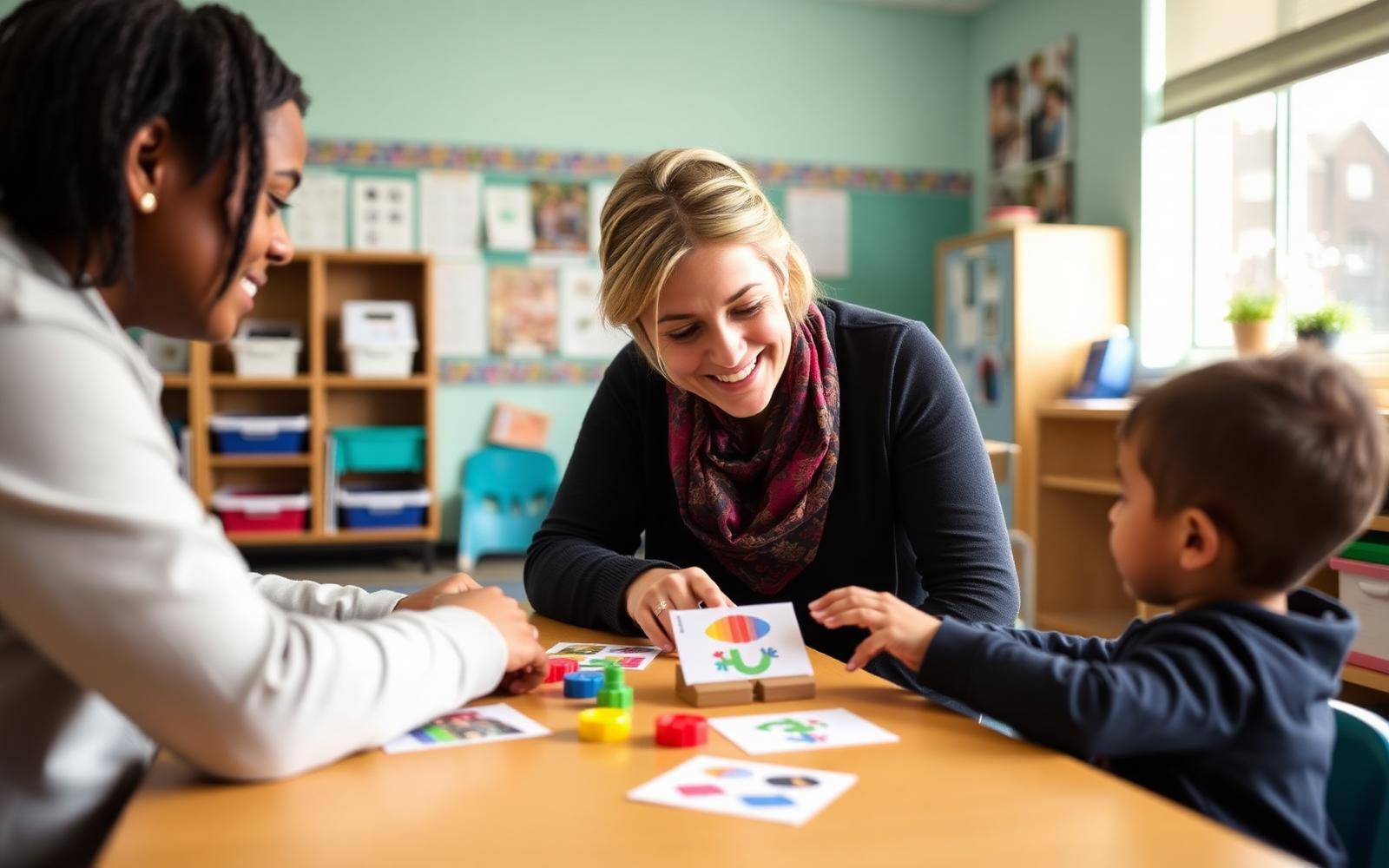
Applied Behavior Analysis — ABA — is one of the most researched approaches in education, and also one of the most misunderstood. For many parents, the phrase brings up images of a child sitting at a table with a clinician, doing "trials" with a token board. That image isn't wrong, exactly, but it's a tiny slice of what ABA can look like when it is thoughtfully embedded into an inclusive school day.
This article is for parents trying to figure out what a school actually means when it says "we use ABA." No jargon. No sales pitch. Just a real look inside what school-based ABA is, what it isn't, and why the two words that matter most are "individualized" and "kind."
What ABA actually is
At its core, ABA is a science of learning. It is the study of how behavior — every behavior, from writing a sentence to raising a hand to melting down at the pencil sharpener — is shaped by what happens before it and what happens after it.
That definition is intentionally broad, because the science is broad. ABA is used with adults recovering from strokes, with employees in workplace safety programs, with athletes learning new skills. In a school, ABA is a set of tools for helping a child learn more, more quickly, with less frustration for everyone involved.
Two things that ABA is not:
- ABA is not a curriculum. It doesn't replace phonics or math or science. It's a way of teaching whatever the curriculum is.
- ABA is not compliance training. Modern, ethical ABA is not about making kids "obey." It's about understanding why a behavior is happening and helping the child build a more useful skill in its place.
Those two clarifications matter, because a lot of the fear around ABA in schools comes from older, table-only, compliance-heavy models that most reputable schools no longer practice.
The three things good school-based ABA is always doing
Regardless of the child, the grade, or the goal, a well-run classroom that uses ABA is doing three things at all times.
1. Watching, not guessing
Every child sends signals all day: the way they walk in, the way they pick up a pencil, the way they respond to an unexpected change. In an ABA-informed classroom, teachers are trained to notice those signals and to record simple data on the ones that matter.
That data is boring to read and life-changing to have. Instead of a teacher telling a parent, "Your child had a rough week," they can say, "Your child had four difficult transitions this week — all of them after lunch, all of them in the hallway, all of them when we moved from a preferred to a non-preferred activity." That level of specificity turns a vague worry into a solvable problem.
2. Building skills, not just stopping behaviors
When a child struggles — refuses a task, leaves the room, cries, hits — the untrained instinct is to shut the behavior down. ABA reframes the question. Instead of, "How do we stop this?" the question becomes, "What skill is this child missing, and how do we teach it?"
A child who screams when the schedule changes may be missing a skill (flexible thinking, asking for information, tolerating uncertainty). A child who leaves the group during reading may be missing a skill (self-advocacy, requesting a break, decoding at the current level). Every "behavior" is data about a missing skill.
Once the missing skill is named, teachers can teach it directly — often in small, playful pieces, over weeks or months. That is the slow, patient, deeply respectful work at the heart of good ABA.
3. Making learning worth it
Every human being does more of what pays off and less of what doesn't. Kids are no exception. ABA leans hard on the science of reinforcement — the study of what makes an action more likely to happen again.
In practice, this looks less exotic than it sounds. It's the teacher who notices first when a child chooses a hard task instead of an easy one. It's the classroom where progress is visible on the wall. It's the intentional choice to celebrate effort, not just correctness. Reinforcement, done right, is not bribery. It's the deliberate act of making sure that hard, brave, growing behavior is seen — and that the world responds when a child stretches.
What a day looks like in an ABA-informed inclusive classroom
Enough theory. Here is what an ordinary morning might look like when ABA is woven into an inclusive K–6 classroom.
Arrival (8:15). A student walks in. The teacher greets them by name and glances at the visual schedule posted at eye level. The child checks off "arrival" and knows what's next. The teacher makes a quick mental note: today's transition into the classroom was smooth. That's data.
Morning meeting (8:30). The class gathers on the rug. A student who struggles with group time is given a specific job — passing out a card, holding the pointer — that gives them a way to be present without being overwhelmed. The teacher is teaching group attending as a skill, not assuming the child already has it.
Reading (9:00). Small groups. A student who typically avoids reading is offered a choice: "Do you want to read to me or to Mr. B first?" Choice is a powerful ABA tool. It preserves the demand — you are going to read — while giving the child ownership. The child picks. Reading happens. Effort gets noticed out loud.
Break (9:45). Everyone moves. Movement breaks aren't a reward or a punishment; they're a scheduled part of how the classroom operates, because we know that most K–6 brains cannot sit for ninety minutes and then perform.
Math (10:00). A student stuck on a new concept gets an extra scaffold: the teacher works one problem out loud, then does one with the child, then watches the child do one. The teacher is using a technique called "I do, we do, you do" — a direct-instruction pattern that overlaps neatly with ABA's emphasis on modeling and gradual release.
Recess and lunch (11:00). Social skills are taught here too. A student who tends to play alone gets a light-touch prompt: "Ella and Jonah are playing four square. Want to try?" A teacher is nearby but not hovering, ready to coach a repair if a conflict happens.
Afternoon (12:30). Project-based work, hands-on science, art. This is where inclusive classrooms shine, because the tasks are open enough that every child can enter at their own level.
Dismissal (2:45). A quick visual review of the day: what went well, what was hard, what's coming tomorrow. Predictability tomorrow starts with a closing today.
Nothing in that day looks like the stereotype of ABA. There are no isolated tables, no drill sessions, no tokens being counted like poker chips. There is careful, consistent, kind teaching — with data quietly running underneath it.
What parents should ask a school that says it "uses ABA"
If you're touring a school that mentions ABA, or you already have a child in a program that does, these are fair questions to ask:
- Who supervises the ABA work? Look for a Board Certified Behavior Analyst (BCBA) or equivalent credential on staff or as a consultant.
- How is data collected, and how do we see it? Parents should have regular, plain-language updates on the specific skills their child is working on.
- How are behavior plans built? They should start with a functional assessment — an honest attempt to understand why a behavior is happening — before any plan is written.
- What does it look like when a child says "no"? In a good ABA-informed classroom, "no" is data, not defiance. The response should be a plan, not a punishment.
- How are parents involved? The best programs treat parents as collaborators, share strategies that work in the classroom, and want to know what works at home.
ABA and inclusion belong together
There is an old and false divide between "inclusion schools" and "ABA programs," as if the two are opposed. In our experience they are strongest together.
Inclusion without structure can leave the most vulnerable kids adrift. ABA without a real classroom can leave kids missing the messy, generalizable practice of being with peers. Woven together, they produce classrooms where every child has a plan, every child has a place, and every child gets to learn.
If you'd like to see what school-based ABA looks like in practice, we welcome families to visit for a full morning. Schedule a tour or read about our Individual ABA program.