
Building Executive Function Skills at Home: 12 Practical Strategies for K–6 Families
Twelve concrete, low-effort ways to build the planning, organization, and self-regulation skills your K–6 child needs — without turning every evening into a battle.
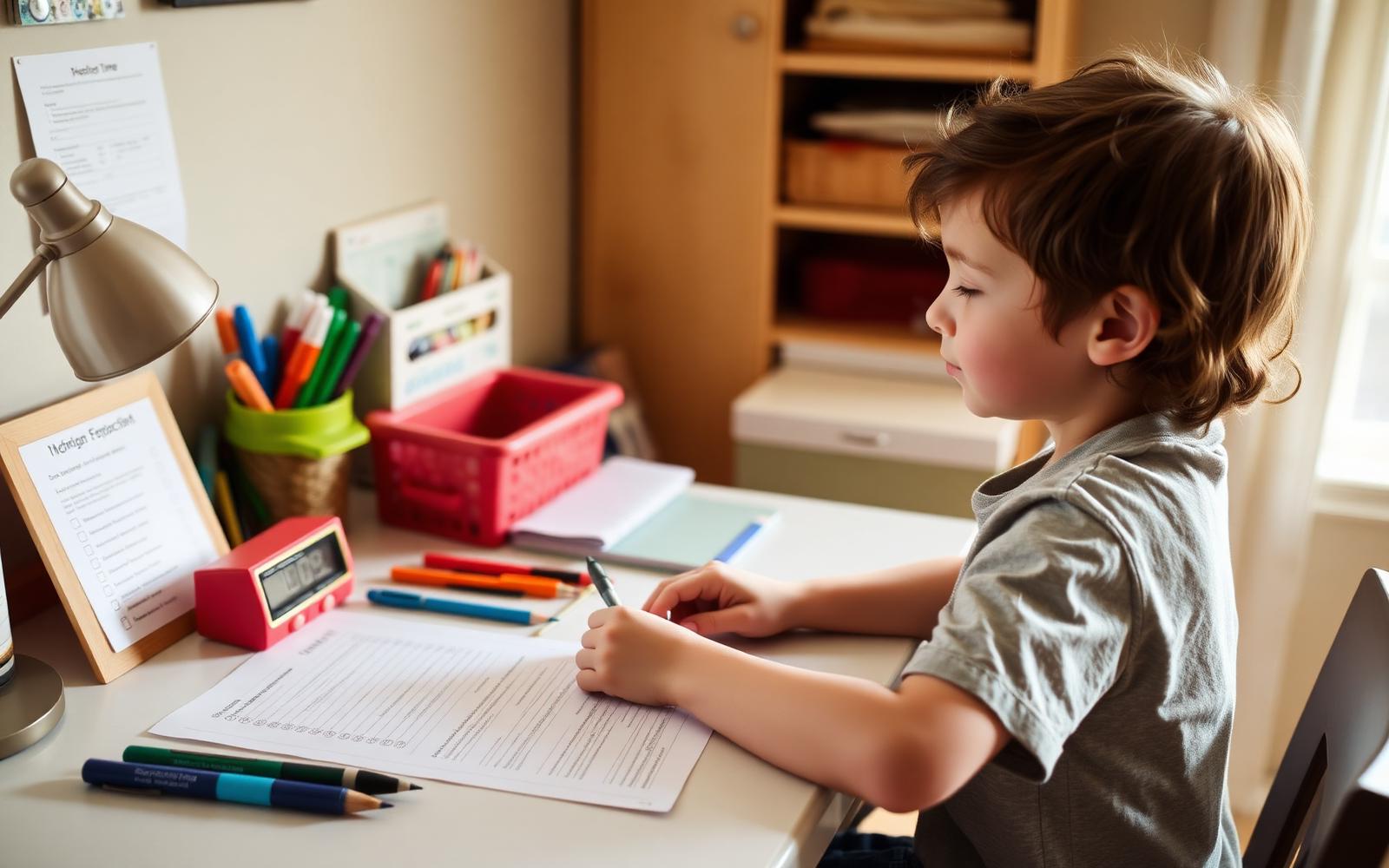
If you have ever asked your child, three times, to go put on their shoes — only to find them ten minutes later on the floor of their room holding one sock and staring at a Lego — you have already met executive function.
Executive function is the family of brain skills that lets a person set a goal, plan for it, gather materials, resist distraction, and finish it. It's the CEO of the brain. And in most children, it is still under construction well into the mid-twenties.
That's the good news and the bad news. The good news: your child is not broken. The bad news: waiting for the skills to arrive on their own is a very long strategy. Executive function is teachable, and the K–6 years are prime real estate for building it.
Here are twelve strategies that work, ordered from easiest to most sophisticated. Pick two or three. Do them for six weeks. Then add more.
1. Make the invisible visible
Executive function starts to fail when a child has to hold too much in working memory. A written or visual list carries the load for them.
Post a morning routine on the bathroom mirror. Put a visual checklist inside the front door. Tape an "after-school" list to the fridge. If your child cannot read yet, use pictures. If they can, use words. Either way, the goal is to move the routine out of your voice and onto a surface.
Bonus points if your child helps make the list. Ownership matters.
2. Use timers relentlessly
Time is an abstraction that most K–6 kids cannot feel. Visual timers make it real.
We recommend a $20 visual timer with a red disk that shrinks as time passes. Use it for tooth-brushing, homework blocks, screen time, transitions between rooms. Your child gets to see the amount of time left, not just be told about it.
Small language shift that matters: instead of "you have five more minutes," say "when the red is gone." One is a sentence for adults. The other is a picture for kids.
3. Front-load transitions
Transitions — from playing to eating, from bath to bed, from home to car — eat more executive function than adults realize. A child who is "fine" all day may fall apart at transition points because that is where the demand spikes.
Give warnings. "In ten minutes, we're going to clean up and eat." "In two minutes, you'll pause the show." Pair the warning with a visual (a timer, a finger count) and, when possible, a preview of what's next ("After dinner, we're doing bath and then two books").
The child who resists transitions isn't defying you. They're being asked to reboot their entire brain, and no one told them the update was coming.
4. Teach one system at a time
Adults sometimes try to overhaul a kid's whole life in one weekend. New homework system, new chores chart, new morning routine, new consequences. It never sticks.
Pick one system to install this month. Just one. Backpack organization, maybe. Or a homework start-time. Or a bedtime routine.
Practice it. Coach it. Celebrate it. In four to six weeks, when it is genuinely automatic, add the next one. Executive function grows by installation, not by declaration.
5. Use "if / then" language for planning
"If you finish your reading, then you can play outside." "If your shoes are on by 7:45, then we have time to stop at the coffee shop."
Explicit if/then framing makes the connection between effort and outcome visible. It is also excellent modeling for the way executive function feels from the inside: sequencing, anticipating, choosing.
Fair warning: if you set an if/then, keep it. Kids notice.
6. Externalize working memory with checklists
For older elementary kids, a small notebook or a note on their tablet can function as an external hard drive.
Teach them to jot down assignments, materials to bring home, ideas they want to remember. This is not "coddling." It is teaching a fundamental adult life skill — every professional you know is running on a to-do list somewhere.
We often tell parents: the goal is not for your child to have a better memory. The goal is for your child to have reliable systems that keep the memory load low.
7. Break big tasks into small ones — out loud
A worksheet with twenty math problems is not one task. It is twenty tasks. Adults see that instinctively. Kids often see one giant, immovable wall.
Sit with your child at the start of a task and narrate the breakdown out loud. "Okay, we've got twenty problems. Let's do the first five, then take a stretch. Then the next five. Then a snack." Draw brackets right on the paper.
You are teaching them how to do the mental move themselves. Six months from now, ask them to do the breakdown out loud. Twelve months from now, they'll do it silently.
8. Build a launching pad
Every family we work with has some version of the same nightly problem: shoes, backpacks, coats, water bottles, and library books scatter across the house between 3 p.m. and 8 a.m.
The fix is a launching pad. Pick one spot near the door. Put a bin, a hook, and a small shelf. Everything that leaves the house in the morning lives in this spot the night before. Everything.
Practice packing the launching pad after dinner. Within a month, the morning chaos will drop by half.
9. Coach recovery, not just performance
Every child will forget the homework, lose the water bottle, blow the bedtime routine. What we do next matters more than the mistake itself.
Instead of a lecture ("You always..."), narrate the recovery ("Okay, we forgot. What's the fix? Do we email the teacher? Do we grab it at drop-off tomorrow? Let's make the plan."). You are teaching a repair loop that will serve them for the rest of their life.
Kids with weak executive function often already have loud inner critics. They don't need us to add to it. They need us to model calm problem-solving.
10. Guard sleep like it's academic support — because it is
Sleep and executive function are inseparable. A K–6 child who is chronically 45 minutes short on sleep is a child whose CEO shows up to work groggy.
Most kids in this age range need 9 to 12 hours. Screens off 60 minutes before bed, ideally out of the bedroom. Same-ish bedtime seven nights a week, including weekends.
If you fix nothing else on this list, fix sleep. Every other strategy works better on a rested brain.
11. Protect one unstructured hour every day
Executive function is built by practicing it, which means kids need time when no adult is telling them what to do.
Unstructured play — real play, not another class, not a screen — is where children practice starting, planning, and finishing on their own. Guard at least one hour of it a day. Boredom is not the enemy. Boredom is when planning muscles get exercised.
12. Model the skill you want to see
The single strongest predictor of a child's executive function is what they see the adults around them doing.
You do not have to be perfect. You have to be visible. Narrate your own planning ("Let me check the calendar before I answer that."). Narrate your own recovery ("Ugh, I forgot the appointment. Let me call and reschedule."). Show them your to-do list. Let them see you use a timer.
Kids don't need lectures on executive function. They need a live-action demo.
A note on kids with ADHD, autism, or other differences
Every strategy on this list works for neurotypical kids. All of them work harder for kids with ADHD, autism, executive function disorder, or learning differences — but they still work. The volume of coaching, the visual supports, and the patience required may all need to go up. That is not a failure. That is the job.
If you are pouring effort into executive function support and still feel stuck, that is a good moment to bring in an occupational therapist, a coach, or a school team that specializes in this work. The tools are the same; the skill of applying them across settings takes practice.
The long game
Executive function does not finish developing in fifth grade. It does not finish in high school. Adults are still learning to run our own brains — it's why we love calendars and podcasts and productivity apps.
Your job in elementary school is not to produce a fully executive-functional child. It is to send them into middle school knowing that their brain is manageable. That there are tools. That when things fall apart, there is a repair loop.
Do that, and the rest of school gets a lot easier.
Curious how these strategies get built into a school day? Our K–6 program teaches executive function skills explicitly, not just when a child struggles. Take a look at our Elementary program or schedule a tour.