Understanding IEPs, 504 Plans, and What Private Schools Can (and Can't) Do
A clear, honest look at how IEPs and 504 plans work when your child attends a private school — what carries over, what doesn't, and how to build the right supports.
If your child has an IEP or a 504 plan, the decision to consider a private school comes with an entirely separate question layered on top: "What happens to my child's services if we leave the district?"
It is a fair question, and the answer is more nuanced than most schools — public or private — will tell you in a single sentence. This article is our attempt to lay it out honestly, so you can make an informed decision and ask the right questions of any school you visit.
Two disclaimers up front. First, education law changes; always confirm current specifics with an educational attorney or your district. Second, this is a general overview — your child's situation may include factors that shift the analysis.
The short version
- IEPs are creations of federal special education law (IDEA). Their strongest form applies to public schools.
- 504 plans come from civil rights law (Section 504 of the Rehabilitation Act). They apply to any program that receives federal funding — which most public schools do and most private schools do not.
- Private schools are generally not required to implement an IEP, but they can — and many good ones do — build individualized programming that meets or exceeds what a district was providing.
- Your child does not lose their disability or their needs when they change schools. What changes is which laws the school is required to follow.
Now let's unpack that.
What an IEP actually is
An Individualized Education Program (IEP) is a legal document produced by a public school district under the federal Individuals with Disabilities Education Act (IDEA). It documents a child's disability, their present levels of performance, their annual goals, and the specific special education and related services the district will provide — free of charge — to help them make progress.
An IEP is binding on the district that wrote it. It is written by a team that includes parents, teachers, and specialists, and it is reviewed at least annually.
Key features of an IEP:
- Free and appropriate public education (FAPE) is guaranteed.
- Least restrictive environment (LRE) is required.
- Specific goals with measurable data must be tracked.
- Related services (speech, OT, PT, counseling) are included if needed.
- Due process rights for parents are extensive.
What a 504 plan actually is
A 504 plan is a shorter document produced under Section 504 of the Rehabilitation Act of 1973. It is a civil rights protection, not a special education entitlement.
A 504 plan says: "This child has a disability that substantially limits a major life activity. Here are the accommodations the school will provide to give them equal access."
Common 504 accommodations include extended time on tests, preferential seating, movement breaks, use of a laptop, or access to a quiet space. A 504 does not typically fund direct services the way an IEP does.
Section 504 applies to any program receiving federal financial assistance. Most public schools do. Most private schools do not.
What happens when you enroll in a private school
Here is where it gets interesting. Under IDEA, children with disabilities who are voluntarily enrolled in private schools by their parents (as opposed to placed there by the district) fall under a section commonly called "equitable services" or "proportionate share."
In plain English:
- Your child's IEP does not automatically transfer to the private school.
- The public school district retains an obligation to offer services to eligible children in private schools within the district, but the level of service is generally much smaller than a full IEP.
- These services are typically offered through a "services plan" (often called an ISP), not a full IEP.
That sounds like a loss — and in one narrow legal sense it is. But in a practical, day-to-day sense, families frequently find that the individualized programming a specialty private school builds is more responsive than what a large public system could provide, even under a full IEP.
What good private schools do instead
A well-designed private school serving children with disabilities does not need IDEA to compel it to do the right thing. It builds internal versions of the same processes:
- Learner profiles. Every student has a written plan describing strengths, challenges, accommodations, and goals.
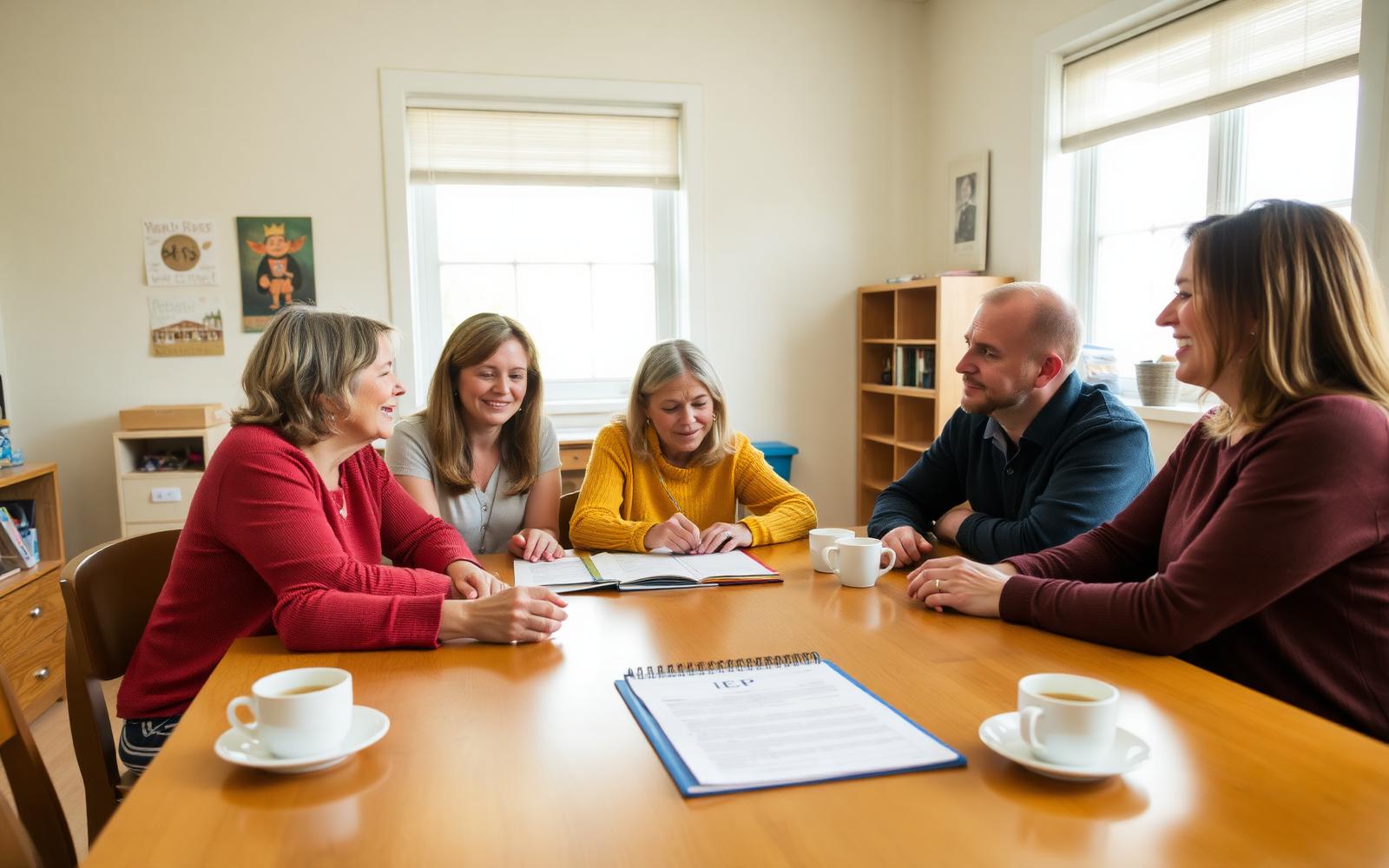
- Small teams that meet often. Teachers, specialists, and parents meet frequently — often quarterly at minimum — to review progress and adjust.
- Direct services embedded in the day. Speech, OT, ABA, counseling, or reading intervention are woven into the schedule, sometimes provided directly by school staff and sometimes by contracted specialists.
- Data-driven decisions. Progress is measured, and adjustments are made based on what the data shows.
- Honest conversations. When a program isn't working, families hear about it early — not at the end of the year.
Ask any private school considering your child: "What does an individual student plan look like at your school, and can I see a sample (de-identified)?" If they can't produce one, that tells you something.
Practical questions to ask about your child's specific services
If your child is receiving specific services on their current IEP, walk through each one with the private school:
Speech-language therapy. Is there a licensed SLP on staff or under contract? How many minutes per week? Individual or group? How is progress reported?
Occupational therapy. Same questions, and additionally: Is OT provided in the classroom, in a separate space, or both?
ABA / behavior support. Is there a BCBA involved? How are behavior support plans written and reviewed? What is the school's philosophy around behavior — is it reactive and punitive, or proactive and skill-building?
Reading intervention. What structured literacy programs (Wilson, Orton-Gillingham, Barton, etc.) does the school use? How is progress measured?
Counseling / mental health. Who provides it? What are the credentials? How are parents kept informed?
Medical or nursing needs. Who administers medication? Who handles medical emergencies? What is the plan for a child with seizures, diabetes, severe allergies, etc.?
Should you keep the IEP active while enrolled privately?
Often, yes. Keeping the IEP active — even while your child is attending a private school — preserves your options. Reasons families choose to keep the IEP open:
- Return to public school may be an option later, and having an active IEP simplifies re-entry.
- Equitable services through the district may still be available (evaluations, some direct services, consultation).
- Records and evaluations stay current, which is useful for future transitions to middle or high school.
You are not required to keep the IEP active, but if you have any thought that your child may return to public school before high school, it's often worth the small amount of paperwork.
What about 504 plans in private schools?
If a private school does not receive federal funding, Section 504 does not apply and a 504 plan from the previous school does not carry legal weight. That said, most private schools with any serious commitment to serving diverse learners will voluntarily implement the same accommodations. Ask.
A quick way to test this: bring your child's current 504 plan (or IEP) to the tour. Ask the admissions director to walk through it accommodation by accommodation and tell you honestly which the school already does, which it can add, and which it cannot support.
Red flags to watch for
Some private schools do not have the infrastructure to serve kids with significant needs, no matter how good their intentions. Warning signs:
- "We treat everyone the same" as a stated philosophy. Equity is not sameness.
- No named specialists on staff or on retainer.
- Vague answers to specific questions about services.
- Pressure to "let your child prove they can succeed without accommodations."
- A history of asking families to leave when things get hard.
You want a school that welcomes your child's paperwork, reads it carefully, and can articulate exactly how they will meet each need.
The bigger picture
An IEP is a promise a school system makes to a child. A private school makes a different promise — usually a smaller, more personal one, in exchange for less legal protection and more institutional agility.
For many families, that trade is exactly right. For others, the protections of a robust public IEP are irreplaceable. There is no universally correct answer, only the one that fits your child.
The families who navigate this transition best are the ones who go in with clear eyes: they know what their child needs, they ask direct questions, they get everything in writing, and they build partnerships instead of assuming systems.
If you'd like to walk through your child's current IEP or 504 with our team and hear an honest read on what we can and cannot support, we'd be glad to. Schedule a tour and bring the paperwork.